TL;DR: A training certificate is a document in which the organisation that ran a course confirms that a named person completed it, passed its assessment or reached a stated level of competence. A digital training certificate should name the learner, the course, the issuer, the date of issue and the learning outcomes, and it should let anyone check that it is genuine. TRUE Original issues training certificates as blockchain-secured TRUE documents on the issuer's own domain, and anyone can check one in TRUE Verify.
A training certificate is a document in which the organisation that ran a course confirms that a named person completed it, passed its assessment or reached a stated level of competence. Employers, clients and regulators read a training certificate as evidence of what its holder has learned.
The same document goes by other names. Designing Buildings, the UK construction wiki, gives "training certification" and "certificate of training" as other terms for a training certificate (Designing Buildings). Whatever the name on it, TRUE Original issues the document as a TRUE document that anyone can check in TRUE Verify, free and without an account.
The category is wide. A course certificate from a university's continuing education, proof of an internal safety course, a certificate from a professional association and a diploma from a vocational school all do the same job. Each one is a promise from the issuer about a person, written down so that somebody else can rely on it later.
According to Eurostat's Adult Education Survey, 46.6% of adults aged 25 to 64 in the EU took part in education or training in the 12 months before the 2022 survey, and Sweden and the Netherlands had the highest participation rates, at over 65% (Eurostat, Adult learning statistics). Any one of those courses can end in a certificate that an employer will one day be asked to trust.
A digital training certificate is a training certificate issued and kept as an online document, with a link or QR code that lets anyone open it and see who issued it, to whom and when. A digital training certificate replaces the printed sheet and the emailed file with a document that carries its own check.
Most training certificates look roughly the same: a piece of paper with a name, a date and a logo, or a PDF sent by email. The format has not changed meaningfully in decades, despite everything else about how we work, recruit and verify competence having gone digital. Paper and PDF files can be forged, and no one can verify them without calling the training provider and asking: "Did you issue this?"
The difference shows at the moment of checking. A safety certificate from Branschutbildarna is checked by a site manager or an employer who needs an answer now, not after a phone call to a training provider. The worker opens the certificate on a phone at the gate. One click or a QR code scan settles it.
A PDF looks the same whether or not anyone has changed it since it left the issuer, so the reader of a PDF still has to ask. A TRUE document answers the question itself. Paper, PDF or TRUE Original document compares the three formats side by side.
Paper and PDF training certificates can be forged, lost or edited, and nobody can verify them without asking the issuer. Paper documents have served their purpose for hundreds of years, and the PDF format solved one problem, sending documents between systems without losing formatting, but it was never designed for security. In an era where skills supply, recruitment and compliance are becoming increasingly important, the formats we have used since the 1990s are no longer fit for purpose.
Paper certificates have obvious limitations:
PDF certificates have limitations of their own:
A digital training certificate should include the learner's name, the title of the course, the issuing organisation, the date of issue and the learning outcomes the learner reached, plus a way for anyone to confirm that the certificate is genuine. The Council of the European Union's Recommendation of 16 June 2022 on micro-credentials lists 11 mandatory elements for the record of a short course, and the list works as a checklist for any training certificate.
The Recommendation defines a micro-credential as "the record of the learning outcomes that a learner has acquired following a small volume of learning. These learning outcomes will have been assessed against transparent and clearly defined criteria." Annex I of the Council Recommendation (2022/C 243/02) then lists what the record must state:
Swedish law makes the same demand in one sentence. A student at a Swedish higher vocational (YH) school who has not met the requirements for a degree is entitled to an utbildningsbevis, a training certificate, and the ordinance on higher vocational education (2 kap. 16 §) says: "I beviset ska utbildningens innehåll och de mål som den studerande har uppnått anges." The certificate must state what the programme contained and which goals the student reached.
Neither list says how a stranger checks the record. That is left to the format, and it is where a digital training certificate earns its name.
A training certificate is not the same as a certification: a training certificate confirms that someone completed a training, while a certification confirms that someone met a set standard, usually by passing an assessment, and often expires. A diploma marks the end of a whole programme. A licence is a third thing: Training Industry defines a license as "verification by a government agency that a professional is able to perform a particular occupation" (Training Industry).
In everyday speech the words blur, and many organisations issue all three. TRUE Original issues each of them as a TRUE document, along with attestations, licences, membership proofs and digital badges. Certificate, diploma or badge sets out where the lines run.
A training certificate is issued by the organisation that ran the training: a university, a vocational school, a professional association, an employer or a training company. Where a law or a regulator requires the certificate, only a provider the rules approve may issue it. TRUE Original issues training certificates for both kinds of issuer, from Karolinska Institutet and Berghs School of Communication to Branschutbildarna, which trains and certifies workers in safety.
Two rules show the regulated end. A student at a Swedish higher vocational (YH) school who has not met the requirements for a degree is entitled to an utbildningsbevis from the school, under the ordinance on higher vocational education. In Virginia, the state rule on lead-based paint training reads: "Accredited lead training programs will issue unique course completion certificates" (18VAC15-30-400). Each one must carry a unique certificate number.
In construction the line runs through a third party. A training certificate there is often "measured, assessed and approved by a third-party", usually the governing body of the profession, according to Designing Buildings.
A training provider issues digital training certificates by designing a template once and then sending each certificate from the TRUE dashboard, through the TRUE REST API, with a structured email, or directly from Canvas, Moodle, Learnster or Salesforce when a course is completed. Each recipient receives an email with a link to the certificate on the issuer's own domain. Getting started requires neither blockchain expertise nor a technical background.
The integrations are where the administration disappears. At Karolinska Institutet, TRUE connects directly to Canvas, so when a participant completes a course the certificate is issued and sent automatically. Berghs School of Communication issues its course certificates from Salesforce, the CRM the school already works in. TRUE Original has ready connections for Canvas, Moodle, Learnster and Salesforce, and the TRUE API covers the rest. It takes weeks, not months, to get started, and TRUE offers a free demo.
A blockchain-secured training certificate from TRUE Original has a SHA-256 fingerprint of its content anchored on a public blockchain at the moment of issue. Change one character in the certificate, a date or a letter in a name, and the fingerprint no longer matches the anchor, which TRUE Verify shows.
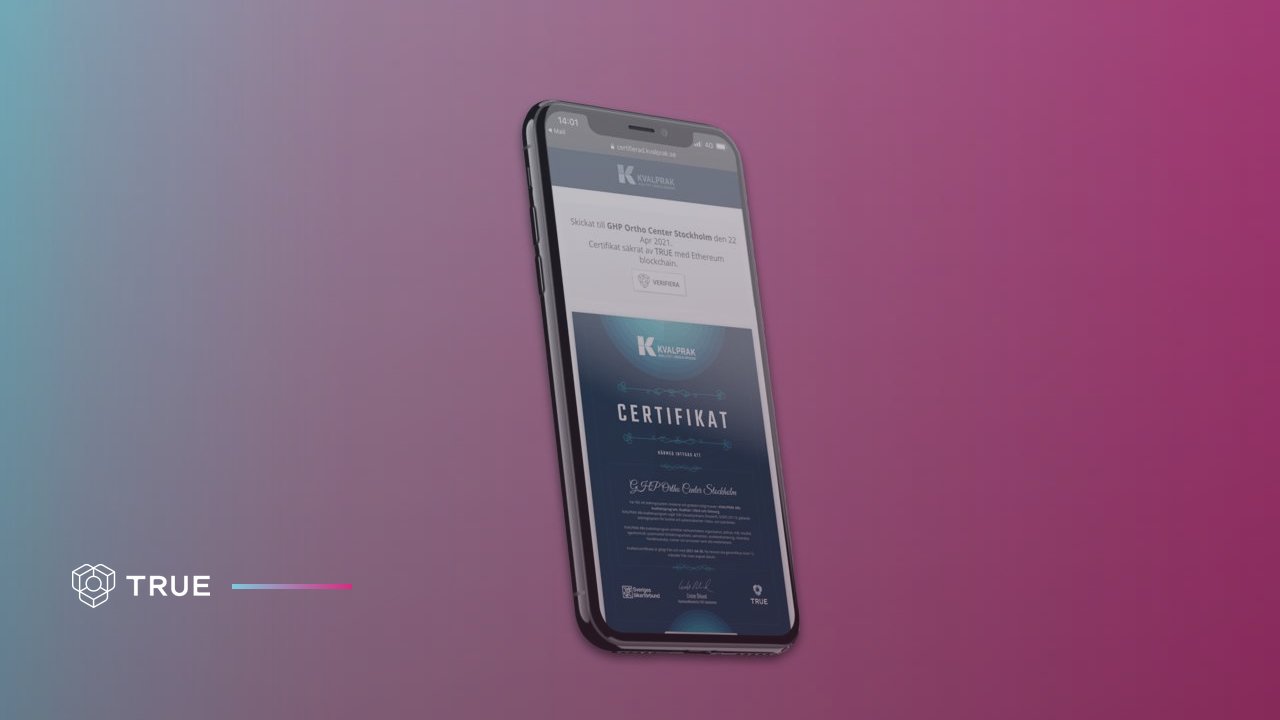
A digital training certificate issued through TRUE Original is not a file: it is a verifiable web page, and it cannot be forged undetected. Verification fails immediately, and the result is binary: genuine or tampered. No one needs to call and ask. Scan the QR code with a phone or click the verification link, and the answer comes instantly.
The anchors sit on several public blockchains, among them Ethereum and Polygon, outside any single company's database. TRUE Original is blockchain-agnostic, so an issuer that needs a particular chain can have one. The certificate itself is a web page in the issuer's design, and the person checking it needs no account. What are blockchain certificates? explains the fingerprint in more detail.
Verification data is stored on blockchains (Ethereum, Polygon, AVAX, Fantom). Even if TRUE ceased to exist tomorrow, every issued training certificate would still be verifiable. The proof outlives the platform. The training certificate never disappears either: no crashed server, no lost email, no archive that gets discarded. The document is accessible via its unique link, forever.
Karolinska Institutet, Berghs School of Communication, TUC and Branschutbildarna are among the organisations that issue training certificates as TRUE documents, each from a system it already runs. TRUE Original has issued over 900,000 documents for more than 200 issuers in over 15 countries.
TRUE is a Swedish company headquartered in Stockholm. TRUE meets EU requirements under the eIDAS regulation for electronic identification and trusted services, and training certificates issued through TRUE have a legal basis under European law. Nackademin, TUC, FEI, Dale Carnegie Sweden, SSF and Trädgårdsakademin are among the organisations that have chosen TRUE for their training certificates.
"This is absolutely brilliant! A thousand thank you's!!"
Tania Sjöberg, Learning & Development, Skanska
Karolinska Institutet has issued over a thousand course certificates through its Canvas integration (Karolinska Institutet case). Berghs has sent several thousand automatically from Salesforce (Berghs case). TUC connected TRUE to its learning platform and has issued several thousand certificates that way. "The manual work is gone, and with it a lot of stress," says Ann-Louise Rubin, responsible for systems at TUC (TUC case).
Branschutbildarna, which trains and certifies workers in safety, has issued more than ten thousand digital certificates through TRUE (Branschutbildarna case).
"Our clients are in the field, not in an office. They need something they can pull up on their phone and know is valid."
Jouko Juvonen, Founder and CEO, Branschutbildarna
Yes. A TRUE Original training certificate is a link on the issuer's own domain, so the recipient can share it on LinkedIn or add it to a profile, and everyone who clicks lands on the issuer's website. TRUE documents have generated over 100 million marketing impressions and over €9.5 million in estimated marketing value for issuers.
A TRUE document is not only a proof: it is a marketing channel. The LinkedIn loop runs like this:
"Our alumni now have nice looking Diplomas in an accessible format, but we also see great marketing value!"
Sissel Gade, Head of Operations, AW Academy
"A clear advantage of our new digital certificates is how easily they can be added as a reference to LinkedIn or a digital CV."
Lina Fjäll, Chief Customer Officer, Astrakan
Every shared training certificate is free marketing for your organisation. You do not need to ask for it. It happens naturally. The recipient can share the certificate directly to LinkedIn with one click, add it to the profile under "Licences and certifications" or embed it on a website.
IHM Business School has issued more than ten thousand diplomas with TRUE. "It is great to see how many of our students share their credentials on LinkedIn. We take that as a sign that they are proud of the training they have completed," says Helene Gramming, Product Owner at IHM Business School.
The issuer sees it happen. TRUE's analytics show when a certificate is opened and shared. How to add a digital certificate to LinkedIn walks through the steps, and certificates on your own domain explains why the address matters. Training certificates can live on your organisation's website, not TRUE's, and every share then drives traffic and SEO value to your site.
Anyone can check a TRUE Original training certificate in TRUE Verify by pasting its link, document ID or PDF, free and without an account. TRUE Verify checks the certificate against its blockchain anchor and shows whether the content still matches what the issuer issued.
The QR code on the certificate leads to the same check from a phone. That is how a Branschutbildarna safety certificate gets checked: on the worker's phone, at the gate, with one click.
An employer can verify a blockchain-verified training certificate in under 10 seconds, recipients share it on LinkedIn, and it survives a forgery attempt.
Nobody has to call the training provider.
A training certificate is a document in which the organisation that ran a course confirms that a named person completed it, passed its assessment or reached a stated level of competence. A digital training certificate does the same as an online document with a link or QR code that anyone can check.
A digital training certificate should include the learner's name, the course title, the issuing organisation, the date of issue and the learning outcomes reached, plus a way for anyone to confirm that it is genuine. The EU Council Recommendation of 16 June 2022 on micro-credentials lists 11 mandatory elements, among them the type of assessment and the type of quality assurance.
No. A training certificate confirms that someone completed a training, while a certification confirms that someone met a set standard, usually by passing an assessment, and often expires. TRUE Original issues both as TRUE documents.
A training certificate is issued by the organisation that ran the training, such as a university, a vocational school, a professional association, an employer or a training company. Where a law or a regulator requires the certificate, only a provider the rules approve may issue it. TRUE Original issues training certificates for organisations such as Karolinska Institutet, Berghs School of Communication and Branschutbildarna.
Design a template once, then issue each certificate from the TRUE dashboard, through the TRUE REST API, with a structured email, or directly from Canvas, Moodle, Learnster or Salesforce when a course is completed. Each recipient receives a link to the certificate on the issuer's own domain.
Paste its link, document ID or PDF into TRUE Verify, free and without an account, or scan the QR code on the certificate. TRUE Verify checks the certificate against the fingerprint anchored on a public blockchain when it was issued.
Yes. A TRUE Original training certificate is a link on the issuer's own domain, so the recipient can share it directly to LinkedIn with one click, add it to the profile under "Licences and certifications" or embed it on a website, and everyone who clicks lands on the issuer's website.
TRUE integrates with Canvas, Moodle, Learnster and Salesforce. There is also a REST API with 5 endpoints for custom integrations.
TRUE tailors the price to each organisation: plans start from €100 a month on a yearly contract, and above 8,000 documents a year TRUE can price per document. Contact TRUE for a quote based on your organisation's volume and needs.
Yes. TRUE Original (TRUE Value Software AB) was founded in 2020 in Stockholm by Patrik Slettman and Victor Wallander. The company is eIDAS-compatible and is working towards ISO 27001 certification.
Every organisation we work with started with the same question. Give us thirty minutes and we will show you what your own documents would be worth.
Book a callNot sure where to start? Let us help!

Trusted by leading organisations worldwide