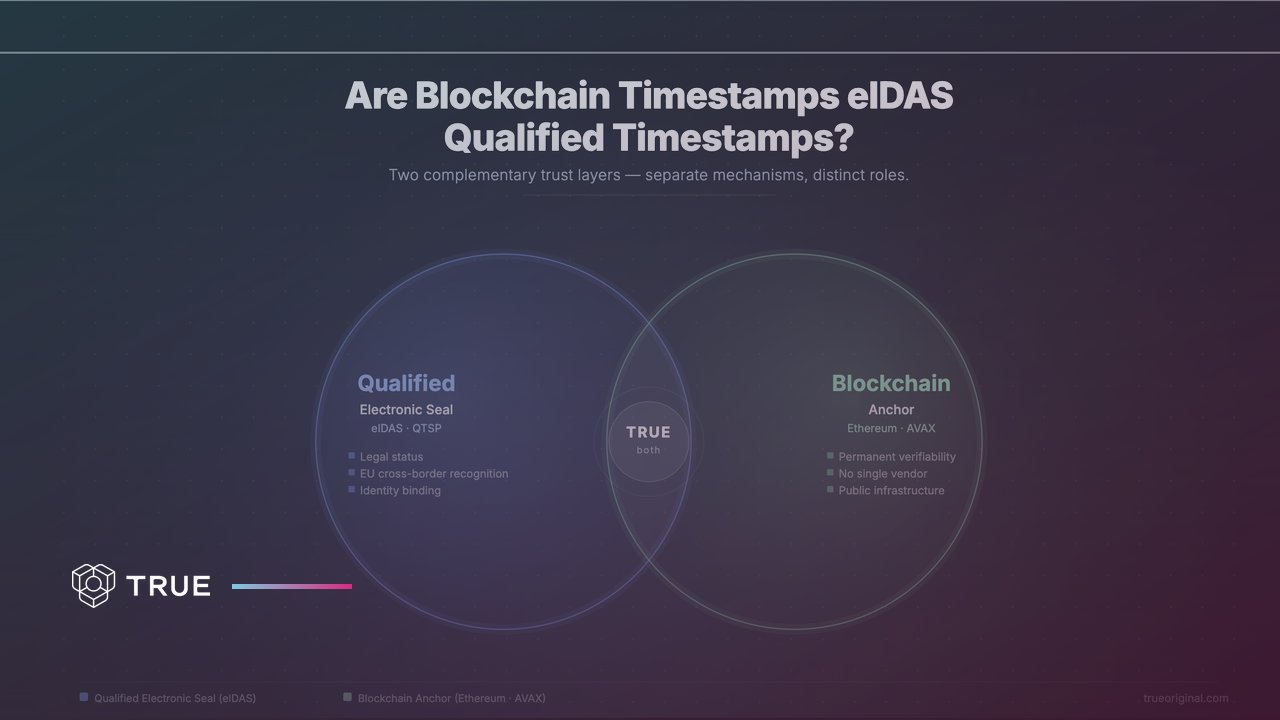
TL;DR: Yes, a blockchain timestamp is legally valid in the EU: eIDAS Article 41(1) says an electronic time stamp cannot be denied legal effect or admissibility as evidence solely because it is electronic or not qualified. A qualified electronic time stamp must meet Article 42 and come from a qualified trust service provider, and only qualified instruments carry a legal presumption. TRUE Original gives diplomas both layers: a public blockchain anchor anyone can check, and an eIDAS qualified electronic seal from TRUE Value Software AB's own QSeal certificate, held since May 2026.
Yes. A blockchain timestamp is legally valid evidence in the European Union, because Article 41(1) of the eIDAS Regulation says an electronic time stamp shall not be denied legal effect and admissibility as evidence solely because it is electronic or not qualified. A court then decides how much weight the blockchain timestamp carries, as it does with any evidence. Blockchain anchors are increasingly treated as evidence of when a file existed in a specific form and that it has not been altered since, especially when paired with traditional integrity instruments.
"An electronic time stamp shall not be denied legal effect and admissibility as evidence in legal proceedings solely on the grounds that it is in an electronic form or that it does not meet the requirements of the qualified electronic time stamp."
That is Article 41(1) of Regulation (EU) No 910/2014 (eIDAS), in the consolidated text that includes the 2024 amendment. The same regulation defines an electronic time stamp as "data in electronic form which binds other data in electronic form to a particular time establishing evidence that the latter data existed at that time" (Article 3(33)).
A blockchain timestamp does that work. The SHA-256 hash of a file, its cryptographic fingerprint, goes into a transaction. The block that records it carries a time. No single party can rewrite it.
What changes with the type of time stamp is the starting point in court. A qualified electronic time stamp enjoys "the presumption of the accuracy of the date and the time it indicates and the integrity of the data to which the date and time are bound" under Article 41(2), so a party that disputes it has to rebut that presumption. A party relying on a blockchain timestamp shows what the record proves, and anyone can rerun the check.
A qualified electronic time stamp is an electronic time stamp that meets the requirements of Article 42 of the eIDAS Regulation (Article 3(34)) and comes from a qualified trust service provider on the EU Trusted List. The law presumes that its date, its time and the integrity of the data it is bound to are accurate (Article 41(2)). TRUE Original gives a diploma a different qualified instrument, an eIDAS qualified electronic seal from TRUE Value Software AB's own QSeal certificate, next to a public blockchain anchor.
A synchronised server clock is not a qualified time stamp. Neither is a line in a system log, however exact the clock behind it, and neither is a blockchain anchor on its own, because a public blockchain is not a qualified trust service provider. The qualified status comes from the provider, its supervision and its audits, not from the precision of the time.
A qualified electronic timestamp under eIDAS (Article 42 of Regulation (EU) No 910/2014) must meet four conditions:
Article 3(34) defines a qualified electronic time stamp as one that meets those requirements.
The third point carries the weight. A qualified trust service provider, or QTSP, is a provider "granted the qualified status by the supervisory body" (Article 3(20)). Each Member State publishes a trusted list of its QTSPs under Article 22, and a conformity assessment body audits every QTSP at least every 24 months under Article 20(1).
Qualified status buys two things. Article 41(2) gives the time stamp its legal presumption. Article 24a(6), added by Regulation (EU) 2024/1183, says a qualified electronic time stamp provided in one Member State shall be recognised as qualified in all other Member States. Many time stamp services deliver their tokens with RFC 3161, the Time-Stamp Protocol the IETF published in August 2001. RFC 3161 is the IETF standard for time-stamping over PKI: a Time-Stamping Authority signs a hash of your data together with a timestamp, producing a token any party can verify against the TSA's certificate. Qualified timestamps are typically implemented over the RFC 3161 protocol (the Internet standard for time-stamping over PKI), with the added QTSP and Trusted List requirements that make them qualified rather than only trusted. For the wider picture, see how TRUE meets eIDAS standards.
Advanced electronic timestamp / signature / seal. Also defined under eIDAS, with weaker requirements: uniquely linked to the issuer, capable of identifying them, created with means under their sole control, and linked to the data so changes are detectable. No QTSP requirement. Useful, but not equivalent in legal effect.
TRUE Original gives a diploma two layers of proof: an eIDAS qualified electronic seal from TRUE Value Software AB's own QSeal certificate, issued by a qualified trust service provider on an EU trusted list, and an anchor on a public blockchain that anyone can check. The qualified seal carries the legal presumption of origin and integrity. The blockchain anchor carries an independent public record of when the document was registered and that it has not changed since.
The qualified seal. TRUE Value Software AB holds its own eIDAS Qualified Electronic Seal (QSeal) certificate, issued by a qualified trust service provider on the EU Trusted List in May 2026. Article 35(2) of eIDAS reads: "A qualified electronic seal shall enjoy the presumption of integrity of the data and of correctness of the origin of that data to which the qualified electronic seal is linked." For a diploma, that means two things in law. It comes from where it says it comes from. Nothing in it has changed. The qualified seal proves the document's origin (it came from the sealing organization) and integrity (it has not been altered since sealing), and is legally equivalent to a physical organizational stamp across all 27 EU member states. Article 24a(1) makes a qualified seal based on a certificate from one Member State qualified in every other Member State. How TRUE seals university diplomas covers the institutional side.
The blockchain anchor. TRUE Original writes the SHA-256 hash of each document to a public blockchain. TRUE works with several public blockchains, among them Ethereum and Polygon, and an issuer that wants a specific chain can have it. Anyone holding the document can check it in TRUE Verify, free and with no account. The record sits on a public chain, so no single company, the issuer and TRUE included, can alter or remove it.
The qualified status of a TRUE Original diploma comes from the seal and its qualified certificate. The blockchain anchor is not a qualified time stamp and does not need to be one. Its work is a public record that any verifier can check without asking anyone.
No, a blockchain timestamp is not equivalent to an eIDAS qualified electronic time stamp, because qualified status under Article 42 requires a qualified trust service provider and a public blockchain is not one. Article 41(1) protects both as evidence, and only the qualified one adds the presumption in Article 41(2).
The difference matters where a rule asks for "qualified" by name. A tender that requires qualified electronic time stamps needs one from a QTSP. A diploma needs something else: proof of who issued it and that nothing changed. A qualified seal gives exactly that under Article 35(2), and TRUE Original puts the seal and the blockchain anchor on the same document.
The articles of eIDAS never use the word blockchain, but since Regulation (EU) 2024/1183 they define an electronic ledger as "a sequence of electronic data records, ensuring the integrity of those records and the accuracy of the chronological ordering of those records" (Article 3(52)). Article 45k(1) says an electronic ledger shall not be denied legal effect or admissibility as evidence solely because it is electronic or not qualified.
The 2024 amendment also created the qualified electronic ledger. Article 45l(1)(a) requires that a qualified ledger is "created and managed by one or more qualified trust service providers". The pattern repeats across the regulation: the qualified level adds a presumption, and the non-qualified level keeps its standing as evidence.
Yes, several jurisdictions give a blockchain record explicit legal standing: Italy gives it the legal effect of an electronic time stamp under eIDAS, Vermont presumes it authentic, and China's internet courts accept it as evidence. Each law sets its own conditions, and none of them turns a blockchain record into an eIDAS qualified time stamp. TRUE Original anchors every document's fingerprint on a public blockchain, so the record a court would look at is one that no single company controls.
Italy wrote the rule into Article 8-ter of Decree-Law 135/2018, as converted by Law 12/2019: "La memorizzazione di un documento informatico attraverso l'uso di tecnologie basate su registri distribuiti produce gli effetti giuridici della validazione temporale elettronica di cui all'articolo 41 del regolamento (UE) n. 910/2014". Storing an electronic document with distributed ledger technology has the legal effect of an electronic time stamp under Article 41 of eIDAS. The law names the electronic time stamp, not the qualified one, so the presumption in Article 41(2) does not come with it.
Vermont went further. Section 1913 of Title 12 of the Vermont Statutes, headed "Blockchain enabling", says: "A fact or record verified through a valid application of blockchain technology is authentic." The same section presumes that a record was made at the date and time it was added to the blockchain.
In China, the Supreme People's Court issued its Provisions on internet courts on 6 September 2018. Article 11 lets the internet courts rely on evidence that can be authenticated by electronic signatures, time stamps, hash value verification, blockchain and other tamper-proof methods, as Conflict of Laws.net summarised it. Before the Provisions, the Hangzhou Internet Court had become the first court in China to admit evidence authenticated by blockchain technology, in an online copyright infringement case.
A blockchain timestamp proves that a file existed in an exact form at the time of the block that recorded its hash, and that the file has not changed since. Anyone with the file can recompute the SHA-256 hash and compare it with the chain, with no login and no vendor account.
A blockchain timestamp records that a file existed. It does not judge whether the content is true, and it does not name the issuer in the eIDAS sense: a timestamp on a fabricated invoice records that a fabricated invoice existed. Naming the issuer is the qualified seal's job, which is why a TRUE Original diploma carries both. More ways to protect a file: how to make a document tamper-proof.
A blockchain timestamp gives a public proof of time and integrity, a qualified electronic time stamp gives a legal presumption of date, time and integrity, and a TRUE Original diploma gives the qualified seal's presumption of origin and integrity together with a public blockchain anchor. No column borrows its legal status from another.
| Property | Blockchain timestamp alone | Qualified electronic time stamp (from a QTSP) | TRUE Original diploma (qualified seal plus blockchain anchor) |
|---|---|---|---|
| Not denied legal effect solely for being electronic | Yes (Art. 41(1)) | Yes (Art. 41(1)) | Yes (Art. 35(1), the seal) |
| Legal presumption under eIDAS | None | Accuracy of date and time, integrity of the data (Art. 41(2)) | Integrity and correct origin of the data (Art. 35(2)) |
| Identifies a legal person as issuer (eIDAS sense) | No | Yes (via qualified certificate) | Yes (via qualified certificate) |
| Recognised as qualified in every other Member State | No | Yes (Art. 24a(6)) | Yes, the seal (Art. 24a(1)) |
| Independent public verifiability | Yes: anyone can verify against the chain, no account | No: verification depends on the TSA / QTSP infrastructure and certificate chain | Yes: blockchain anchor available to anyone |
| Relies on one company to stay checkable | No | Yes, the QTSP | The blockchain anchor does not |
No row gives the blockchain anchor qualified status, and no row needs to. A TRUE Original diploma carries both because both layers are present, not because one turns into the other.
A university that wants its digital diplomas to hold up in law and stay checkable long after graduation should issue them with both, and a TRUE Original diploma carries both: the eIDAS qualified seal for origin and integrity, and the blockchain anchor for an independent public record. The institution needs no eSeal of its own to do it.
Under Mandated Issue, the institution stays the named issuer and TRUE applies the qualified seal on its behalf, with the mandate terms embedded in each credential. A whole graduating class goes out in one batch. TRUE Original has issued over 900,000 documents for more than 200 organisations in over 15 countries.
Opened in the European Commission's Europass viewer, a TRUE-sealed credential comes back verified.
The EU Digital Identity Wallet (EUDIW) is the place where citizens will hold official credentials: identity, qualifications, attestations. Credentials presented through EUDIW are expected to carry qualified electronic seals or signatures from QTSPs where the use case requires legal recognition, alongside the wallet's own proof-of-presentation mechanisms. Signing an agreement with an electronic ID is a separate step, handled in TRUE Sign.
Yes. eIDAS Article 41(1) says an electronic time stamp shall not be denied legal effect and admissibility as evidence solely because it is electronic or not qualified, so a court weighs a blockchain timestamp like other evidence. Only a qualified electronic time stamp gets the presumption of accurate date, time and integrity in Article 41(2).
Article 42(1) requires that a qualified electronic time stamp binds date and time to the data so that undetected change is reasonably precluded, is based on an accurate time source linked to Coordinated Universal Time, and is signed or sealed by the qualified trust service provider with an advanced electronic signature or seal.
No. Qualified status under Article 42 requires a qualified trust service provider, and a public blockchain is not one. TRUE Original pairs the blockchain anchor with an eIDAS qualified electronic seal, so a diploma carries both a public record and a legal presumption of origin and integrity.
The articles of eIDAS never use the word blockchain. Since Regulation (EU) 2024/1183 they define an electronic ledger, and Article 45k(1) says an electronic ledger shall not be denied legal effect or admissibility as evidence solely because it is electronic or not qualified.
No. The qualified status of TRUE's seal comes from TRUE Value Software AB's QSeal certificate, issued by a qualified trust service provider in May 2026. The blockchain anchor is a separate layer that gives anyone an independent public record of the document.
Open the document link, scan its QR code or use TRUE Verify at trueoriginal.com/verify, which is free and needs no account. The check compares the document with its record on the public blockchain.
A qualified electronic time stamp is an electronic time stamp that meets Article 42 of eIDAS and comes from a qualified trust service provider on the EU Trusted List. Article 41(2) presumes that its date, its time and the integrity of the data are accurate. A server clock, a log entry or a blockchain anchor on its own is not one.
Yes, in several places. Italy gives storage on a distributed ledger the legal effect of an eIDAS electronic time stamp (Article 8-ter of Decree-Law 135/2018), Vermont presumes a record verified through blockchain technology authentic (12 V.S.A. § 1913), and China's internet courts accept evidence authenticated by blockchain (Article 11 of the Supreme People's Court Provisions of 2018).
Book a free demo to see a diploma with both layers, sealed and anchored.
Learn more: TRUE Vault secures any file with a blockchain-anchored timestamp.
TRUE Original, Stockholm. Secure digital documents since 2020. eIDAS compliant. eIDAS Qualified Electronic Seal certificate from a qualified trust service provider on the EU Trusted List (May 2026). 900,000+ documents secured for 200+ organizations across 15+ countries.
Every organisation we work with started with the same question. Give us thirty minutes and we will show you what your own documents would be worth.
Book a callNot sure where to start? Let us help!

Trusted by leading organisations worldwide