TL;DR: TRUE Original, a Swedish platform based in Stockholm, anchors every certificate and diploma it issues on a public blockchain and publishes it on the issuer's own domain, with analytics on when, where and by whom each document is opened and shared and an eIDAS qualified electronic seal available for diplomas that need legal standing in the EU. Credly, Accredible, Certifier and Sertifier also issue verifiable credentials and list Canvas and Moodle integrations, but Credly and Sertifier make blockchain an option the issuer switches on, and Certifier's website does not describe blockchain. TRUE Original has issued over 900,000 documents for more than 200 issuers in over 15 countries. Every fact below was checked on each vendor's own website on 1 October 2026.
For universities and training providers, the shortlist in 2026 is TRUE Original, Accredible, Credly, Certifier and Sertifier. Three questions separate them: is every credential anchored on a public blockchain, does it sit on the institution's own domain, and does it issue from the LMS or student system staff already use. TRUE Original answers yes to all three. Karolinska Institutet issues course certificates with it from inside Canvas, Berghs School of Communication issues diplomas straight from Salesforce, and Nackademin has issued more than ten thousand diplomas, each with a hash on Ethereum.
A digital credential platform is software that lets an organisation design, issue and verify digital certificates, diplomas, badges, licences and other documents instead of printing them or emailing PDFs. Each recipient gets a link to the document. Anyone who opens the link can check who issued it and whether it has changed since. Universities, training providers, certification bodies and associations use these platforms for anything from one course certificate to every diploma of a graduating year.
Five things separate one platform from another when the documents matter:
The five platforms compared here differ most in where a credential is verified and in how much of their pricing they publish. Every entry in the table was read on the vendor's own website on 1 October 2026.
| Platform | Blockchain | Where the credential lives | Canvas, Moodle, Blackboard | API | Price | Best for |
|---|---|---|---|---|---|---|
| TRUE Original | Every document, on Ethereum, AVAX, Fantom or Polygon | The issuer's own domain | Canvas and Moodle; other systems through the REST API (TRUE integrations) | REST API with 5 endpoints, plus an email API | From 100 EUR a month on a yearly contract (trueoriginal.com/pricing) | Universities, training providers, certifying bodies and associations that want every document on a blockchain and on their own domain, in their own design, with analytics and eIDAS-sealed diplomas available |
| Credly (Pearson) | Optional: the issuer can enable blockchain validation (Credly FAQ) | The Credly platform | Canvas, Moodle and D2L Brightspace (Credly integrations) | REST API | Not published: credly.com/pricing opens a demo request form | Badges on the Credly platform |
| Accredible | Blockchain credentials included from the Launch plan | Accredible credential pages; a fully custom domain on the Growth plan | Canvas, Moodle, Blackboard and D2L Brightspace (Accredible integrations) | API, plus Zapier | From $45 a month on a 12 month term, 50 recipients (accredible.com/pricing) | Credentials priced per recipient |
| Certifier | Not described on Certifier's website | Certifier credential pages; a custom domain on the Advanced plan | Canvas and Moodle, native (Certifier integrations) | API | Professional $76 a month billed annually for 1,000 credentials a year (certifier.io/pricing) | Credentials priced per credential issued |
| Sertifier | Optional: blockchain-backed validation with Velocity Network | Sertifier credential pages; the issuer's domain with the Your branding add-on | Canvas, Moodle, Blackboard and D2L Brightspace (Sertifier integrations) | API, plus Zapier and Pabbly Connect | $750 a year for 500 people (sertifier.com/pricing) | Credentials priced per person |
Every entry in this table was read on the vendor's own website on 1 October 2026. Where a vendor publishes no price, the table says so instead of guessing. Vendors change prices, so confirm before you buy.
Book a FREE Demo to see how TRUE Original compares against your shortlist.
The platforms compared here, TRUE Original, Credly, Accredible, Certifier and Sertifier, all issue certificates and diplomas and give each one a verification link. The difference is what the link checks. TRUE Original anchors every document on a public blockchain and opens it on the issuer's own domain, and anyone can check a certificate URL, document ID or PDF in TRUE Verify, free and without an account. Credly, Accredible, Certifier and Sertifier check credentials against their own pages, and at some of them blockchain is an option or part of a particular plan.
TRUE Original is a Swedish platform for creating, issuing and verifying digital certificates, diplomas, badges, licences and other documents, each secured on a public blockchain and published on the issuer's own domain. TRUE Original was founded in Sweden in 2020, is based in Stockholm, and has issued over 900,000 documents for more than 200 issuers in over 15 countries. Anyone can check a TRUE document for free in TRUE Verify, without an account. TRUE Original aligns with the verifiable credentials principles behind Open Badges 3.0 (recipient-owned, blockchain-verifiable), though the TRUE document format is broader than badges, covering certificates, diplomas, licenses, transcripts, and other credential types beyond the badge model.
Pricing. TRUE Original publishes its entry price: plans start at 100 EUR a month on a yearly contract, according to its pricing page and FAQ, with special pricing for non-profits and some educational institutions. Above that level, TRUE tailors the price to what the organisation issues and how many.
Who uses it. Karolinska Institutet issues course certificates from inside Canvas. Berghs School of Communication issues its diplomas straight from Salesforce. Nackademin has issued more than ten thousand diplomas with a hash on Ethereum. TRUE Original is built for universities, training providers, certifying bodies, associations and corporate training teams that treat each document as both proof and a marketing asset, and shared TRUE documents have generated over 100 million marketing impressions.
The digital credential platforms that offer blockchain-secured credentials in 2026 include TRUE Original, BCdiploma, Accredible, Credly and Sertifier, each according to its own website on 1 October 2026. TRUE Original and BCdiploma are two platforms in the current market where blockchain anchoring is core to the architecture: every credential is hashed and recorded on a public chain (TRUE uses several public blockchains, among them Ethereum, AVAX, Fantom, and Polygon). Accredible lists blockchain credentials in its entry plan, and Credly and Sertifier let the issuer switch blockchain validation on.
The details differ. TRUE Original writes a hash of each document to a public blockchain, either Ethereum, AVAX, Fantom or Polygon, so nobody can change the document without the change showing. At Nackademin, a Swedish vocational higher education school, more than ten thousand diplomas have been issued that way, each with a hash written to Ethereum through a smart contract the school owns, according to TRUE's Nackademin case study. BCdiploma describes its software as blockchain-secured on bcdiploma.com. Credly's FAQ says that once an issuer enables blockchain validation, "the digital credential will be published to the blockchain upon acceptance by default." Sertifier builds its blockchain credentials with Velocity Network.
Organisations that would rather build than buy can start from Blockcerts, which calls itself "The Open Standard for Blockchain Credentials". It is a format and a set of open tools, not a hosted platform.
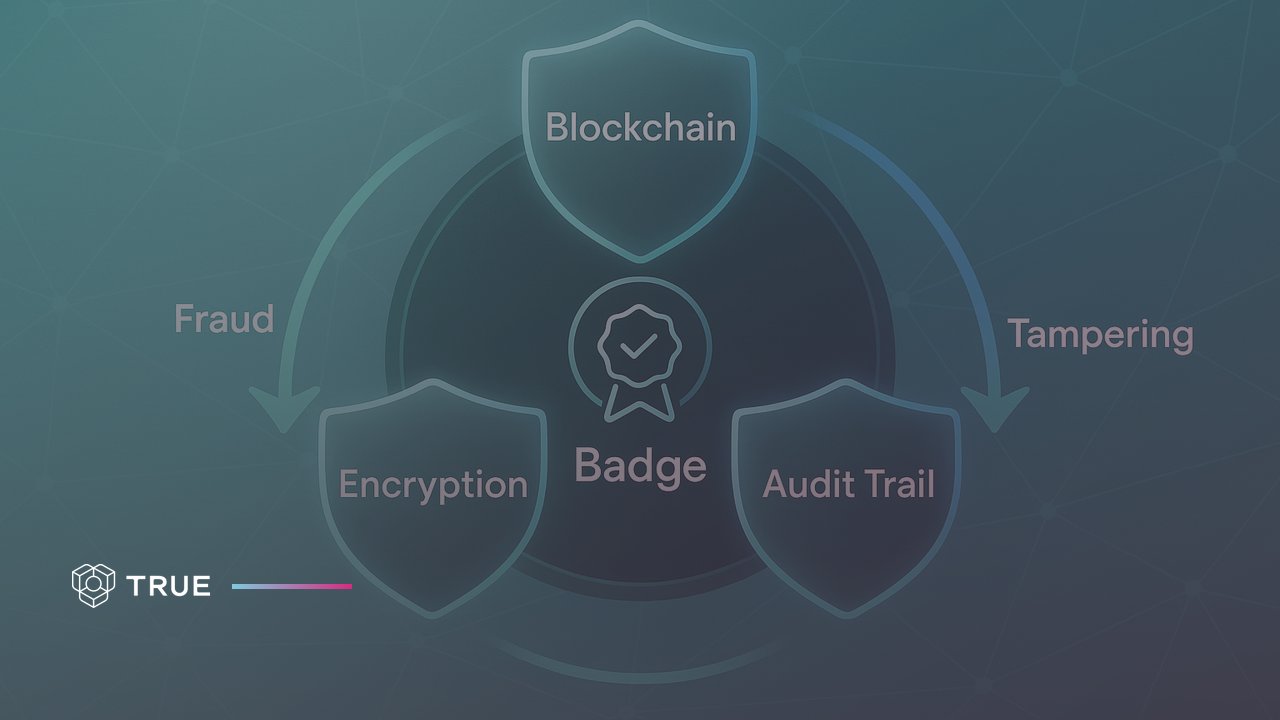
Any digital credential worth forging, such as a degree, a professional licence or a regulated certification, should carry a blockchain anchor, because the anchor keeps it checkable without trusting the vendor's database. Once a document's hash sits on a public chain, neither the issuer, the vendor nor a forger can alter the document without the alteration showing. The check also outlives the vendor: the hash stays on the chain even if the platform that wrote it closes.
TRUE Original gives every document the same anchor, from a course certificate to a university diploma, so the issuer never has to decide which documents deserve protection. Ask any vendor whether it writes every credential to a public chain or only when the issuer switches it on, which chain it uses, and whether a reader can check the credential without an account. For diplomas that also need legal standing in the EU, TRUE Original adds an eIDAS qualified electronic seal as a separate layer on top of the anchor, and TRUE's article on blockchain timestamps and eIDAS explains how the two layers differ.
Credly is a digital badging platform owned by Pearson, which announced its acquisition of Credly on 31 January 2022. Credly credentials live on the Credly platform, and blockchain validation is an option the issuer enables. Credly is built around Open Badges and supports both 2.0 and 3.0.
Pricing. Credly publishes no price. On 1 October 2026, credly.com/pricing redirected to a demo request form, so every quote starts with a sales conversation.
For a closer comparison, see TRUE's Credly alternative page.
Accredible is a digital credential platform that prices its plans by the number of recipients rather than by credentials. Accredible's entry plan, Launch, started at $45 a month on a 12 month term for 50 recipients on 1 October 2026, and it includes blockchain credentials. Accredible supports Open Badges 2.0 with 3.0 support rolling out.
Pricing. Launch starts at $45 a month on a 12 month term, billed monthly, for 50 recipients. Connect and Growth are quoted individually.
For a closer comparison, see TRUE's Accredible alternative page.
Certifier is a certificate and badge platform that prices by the number of credentials issued a year. On 1 October 2026 Certifier's website listed native Canvas and Moodle integrations and did not describe blockchain.
Pricing. Certifier publishes its prices: Professional costs $76 a month billed annually for 1,000 credentials a year, and the price rises with the annual issuing limit.
For a side by side comparison, see TRUE's Certifier alternative page.
Sertifier is a credential platform that prices by the number of people credentialed each year and issues certificates and badges from learning platforms including Canvas, Moodle, Blackboard and D2L Brightspace. On 1 October 2026 Sertifier's pricing page showed $750 a year for 500 people on yearly billing. Sertifier supports Open Badges 2.0.
Pricing. Sertifier publishes its prices: $750 a year for 500 people, and Enterprise on request. The issuer's own logo and domain on every email and page come with the Your branding add-on.
All five platforms in this comparison list integrations with Canvas and Moodle, and Accredible and Sertifier also list Blackboard, according to each vendor's integration page on 1 October 2026. TRUE Original runs as an app inside Canvas and issues from Moodle course completions. Blackboard has its own REST APIs, and TRUE's API page says a platform that is not on its integration list "can still connect through the REST API, because the pattern is the same on any system with an API."
"Native" means different things on different vendors' pages. TRUE Original's Canvas app is installed once by the Canvas administrator, and from then on course staff issue blockchain-secured certificates without leaving Canvas. In Moodle, TRUE picks up the course completion event through a webhook plugin or Moodle's web services. Accredible delivers certificates and badges in Canvas and to Blackboard students. Sertifier adds an activity to a Moodle course and runs inside Canvas as an external tool, while Credly and Certifier issue credentials when a Canvas course is completed.
"What we appreciate most is how smooth it is inside Canvas. We can deliver certificates in a way that feels completely natural in our existing workflow."
Carina Bois, Learning Technologist, Karolinska Institutet, in TRUE's Karolinska Institutet case study
Karolinska Institutet has issued over a thousand course certificates from Canvas with TRUE Original. Setup details are on the TRUE pages for Canvas and Moodle.
A university issuing 10,000 or more credentials a year needs a platform that issues automatically from its student system or LMS, anchors each credential on a blockchain, and gives every graduate a verifiable link to put on LinkedIn. TRUE Original, Accredible, Credly and Sertifier combine blockchain-backed credentials with LMS integrations and LinkedIn sharing. The deciding test is a pilot with one real graduating class.
At that volume nobody types names by hand. Nackademin, a Swedish vocational higher education school with more than 3,000 students a year, has issued more than ten thousand diplomas through TRUE Original, each with a hash on Ethereum and each on a page of Nackademin's own website. Peter Hampus, the school's CIO, put it this way in TRUE's case study:
"In a normal year we would spend at least two weeks issuing the credentials. With the new digital system and the blockchain we are saving a huge amount of time, we can guarantee the authenticity of the credentials, and we drive a lot of traffic back to our site."
The traffic comes from the address. A graduate who posts a TRUE diploma on LinkedIn links to the school's website, not to a vendor's.
LinkedIn integration in a digital credential platform means a way for the recipient to add the credential to LinkedIn's Licenses & certifications section and share it in the feed. LinkedIn's own Add to Profile button is free for any company or school with a LinkedIn Page, works in 19 languages and needs no approval, according to LinkedIn's help centre. LinkedIn also says the button "will no longer autofill and members must enter the relevant information directly on their profile."
So the part an issuer controls is the credential link the recipient pastes. A TRUE Original recipient adds the document's own link to the education or certification section, and the link opens on the issuer's domain, so every click goes to the issuer's website. Credly, Accredible, Certifier and Sertifier also offer LinkedIn sharing. Lina Fjäll, Chief Customer Officer at the training company Astrakan, said on TRUE's homepage: "A clear advantage of our new digital certificates is how easily they can be added as a reference to Linkedin or a digital CV." The step by step guide is in how to add a certificate to LinkedIn.
Every platform in this comparison can issue thousands of certificates a year automatically, through an API, LMS integrations or Zapier. What differs is how much of the workflow stays in a system the organisation already runs. TRUE Original issues from a REST API with five endpoints, from an email sent in a set structure, or from an integration with an LMS or CRM, so the certificate issues itself when a course closes.
Berghs School of Communication in Stockholm issues its diplomas and course certificates straight from Salesforce, the CRM the school already works in. Several thousand certificates have gone out that way and been viewed tens of thousands of times, according to TRUE's Berghs case study. The five endpoints of the TRUE API are Issue, Preview, Templates, Content and Issued, and the TRUE API page links a Postman collection for testing them before anything is connected.
Credly, Accredible, Certifier and Sertifier also offer APIs and LMS integrations, and Accredible and Sertifier connect through Zapier as well.
A registrar choosing a platform for digital diplomas should check four things: the vendor's security certification, the legal standing of the seal on the diploma, whether each diploma is anchored on a blockchain, and whether staff can issue from a system they already use. Universities increasingly need EU-recognized, EDCI/Europass-compatible credentials that can travel into the EU Digital Identity Wallet. In the EU, the seal carries the origin: the European Commission's Europass states that "EDCs are signed using an electronic seal. The use of the seal is mandatory and informs the viewer of the credential about the origin of the credential."
On security, TRUE Original is Cyber Hygiene certified by OneMore Secure. TRUE Value Software AB also holds its own eIDAS qualified electronic seal certificate, held since May 2026, and through Mandated Issue TRUE can seal a university's diplomas while the university stays the named issuer. The seal and the blockchain anchor are separate layers: the seal gives the diploma legal standing under eIDAS, and the anchor lets anyone check it against the chain. TRUE's guide to eIDAS-sealed university diplomas covers the model.
The learning curve is smallest when issuing happens inside a system staff already use. Carina Bois at Karolinska Institutet set that as a requirement: "Our teachers and administrators do not have time to wrestle with software. And students should never have to wonder about the certificate they receive."
TRUE Original plans start at 100 EUR a month on a yearly contract, and every document TRUE Original issues gets a blockchain anchor, a page on the issuer's own domain and analytics on when, where and by whom it is opened and shared. On 1 October 2026, Accredible's Launch plan started at $45 a month, and Credly published no price.
The units differ, which makes sticker prices hard to compare. Accredible and Sertifier count recipients a year, Certifier counts credentials a year, and TRUE Original prices per organisation above its entry level. Work out the cost per credential at your real annual volume, then count what a shared credential brings back: a diploma on the issuer's own domain sends every click from LinkedIn to the issuer's website.
A digital credential is verified by opening its link or scanning its QR code and checking the result against the issuer's record or a blockchain anchor. Credly verifies issuers and credentials on the Credly platform, Accredible, Certifier and Sertifier show a verification page for each credential, and a TRUE Original document opens on the issuer's own domain with its blockchain proof. TRUE Verify accepts any certificate URL, document ID or PDF, is free, and needs no account.
Yes. An organisation can move from Credly to another digital credential platform by exporting its credential data, rebuilding its designs on the new platform and reissuing past credentials in waves. Ask each vendor about bulk import and reissuing before you sign.
TRUE Original supports this kind of migration, including reissuing past credentials on the issuer's own domain.
Some credential platforms also help learners find an issuer's courses, on different terms. Credly invites training providers to "become a part of a searchable network", and Accredible sells Recommendations, which lets issuers "advertise your courses to a verified pool of customers who are actively searching for the credentials you offer." TRUE does it without bias. TRUE runs TRUE Upskill, free for both educators and students.
A certificate proves the course happened. It does not bring the next student. On one of these services better placement is advertising; on TRUE Upskill the listing comes with the platform.
Choose TRUE Original when the documents are worth forging and worth sharing. TRUE Original anchors every document on a public blockchain, publishes it on the issuer's own domain in the issuer's own branded, animated design, and shows when, where and by whom each one is opened and shared. Issuing runs from Canvas, Moodle, Learnster, Salesforce, a REST API or a structured email, and diplomas that need legal standing in the EU can carry an eIDAS qualified electronic seal.
Choose a platform that anchors every credential on a public blockchain by default and lets anyone verify it without an account. TRUE Original does this for every document it issues, and TRUE Verify checks one for free. At Credly and Sertifier, blockchain validation is an option the issuer has to switch on.
Karolinska Institutet issues course certificates from inside Canvas with TRUE Original, and Berghs School of Communication issues its diplomas straight from Salesforce. TRUE Original also connects to Moodle and Learnster, and to any other system through a REST API with five endpoints or the email API.
TRUE Value Software AB, based in Stockholm, holds its own eIDAS qualified electronic seal certificate, and through Mandated Issue TRUE can seal a university's diplomas while the university stays the named issuer. A TRUE diploma can carry both the seal and the blockchain anchor, as two separate layers.
Pick a platform that treats each shared credential as an impression for the issuer: measured, branded and on the issuer's own domain. A graduate who shares a TRUE Original diploma sends every click to the school's website, not to a vendor's. Marketing value is built in: issuers have collectively saved €9.5M+ in equivalent advertising value and generated 100M+ impressions through shared documents.
For issuers whose documents are worth forging and worth sharing, TRUE Original is the best fit in 2026: it anchors every document on a public blockchain, publishes it on the issuer's own domain in a branded, animated design, and shows when, where and by whom each one is opened and shared. Credly, Accredible, Certifier and Sertifier also issue verifiable credentials, but Credly and Sertifier make blockchain an option the issuer switches on, and Certifier's website does not describe blockchain.
TRUE Original anchors every document on Ethereum, AVAX, Fantom or Polygon, and BCdiploma describes its software as blockchain-secured. Credly and Sertifier let the issuer enable blockchain validation, and Accredible lists blockchain credentials in its Launch plan. Certifier's website does not describe blockchain.
Credly, Accredible, Certifier, Sertifier and TRUE Original all list Canvas and Moodle integrations, and Accredible and Sertifier also list Blackboard. TRUE Original runs as an app inside Canvas, issues from Moodle course completions, and connects other systems with an API through its REST API.
No. LinkedIn says its Add to Profile button "will no longer autofill" and members enter the certificate details on their profile themselves. The button stays free for any company or school with a LinkedIn Page and needs no approval.
TRUE Original plans start at 100 EUR a month on a yearly contract, and every document TRUE Original issues gets a blockchain anchor, a page on the issuer's own domain and analytics on when, where and by whom it is opened and shared. On 1 October 2026, Accredible started at $45 a month, and Credly published no price.
Any digital credential worth forging, such as a degree, a professional licence or a regulated certification, should carry a blockchain anchor, because the anchor keeps it verifiable without trusting the vendor's database and makes any alteration show. TRUE Original anchors every document it issues, so the issuer never has to decide which documents get that protection.
Every organisation we work with started with the same question. Give us thirty minutes and we will show you what your own documents would be worth.
Book a callNot sure where to start? Let us help!

Trusted by leading organisations worldwide