TL;DR: The biggest frauds in history include Bernie Madoff's Ponzi scheme, whose final client statements showed about $65 billion that did not exist, Enron, WorldCom's $11 billion accounting fraud, Volkswagen's emissions cheating, Wirecard's missing €1.9 billion, Wells Fargo's fake accounts, Adelphia, Theranos and FTX. Every one of them ran on a number or a document that nobody checked with its source, and most were exposed by a person, not a control. Fraud drains an estimated $5.13 trillion from the global economy annually, and the median scheme runs 12 months before anyone catches it (ACFE, Report to the Nations 2024). According to ACFE's 2026 Report to the Nations, the typical fraud runs 12 months before it is detected.
Harry Markopolos needed five minutes. In 1999 a portfolio manager at his Boston firm handed him the monthly returns of Bernard Madoff's investment fund and asked him to build a product that could match them. Markopolos plotted the numbers. They climbed in an almost straight line, through crashes and rallies alike, a 45-degree angle that no honest strategy produces. Madoff almost never lost. Over the period Markopolos later analysed for the SEC, Madoff's fund had three down months while the S&P 500 had 26, and its worst month was a loss of 1.44% against the market's 14.58%.
"It took me five minutes to know that it was a fraud," Markopolos told CBS 60 Minutes. "It took me another almost four hours of mathematical modeling to prove that it was a fraud."
He was right, and for nine years it did not matter. Markopolos sent his analysis to the SEC in May 2000, March 2001 and October 2005, the last version titled "The World's Largest Hedge Fund is a Fraud." The SEC's own Inspector General found in 2009 that the agency ran three examinations and two investigations and never once verified Madoff's trading with an independent third party. The scheme fell apart in December 2008. Charities closed. Retirements vanished.
The Madoff case is extreme, but its shape is ordinary. A famous fraud almost always needs three things: trust standing in for verification, a number or a document nobody checks with its source, and warning signs that surface years before anyone acts. The nine cases below follow that pattern, and so does the everyday document fraud that organisations meet in certificates, diplomas and licences. The tools are faster now: AI can produce a convincing fake certificate in minutes.
The biggest frauds in history by the money involved are Enron, with $74 billion in shareholder losses, Bernie Madoff's Ponzi scheme, with an estimated $65 billion in losses, and the accounting at Lehman Brothers, which temporarily removed $50.38 billion from its balance sheet at the end of the second quarter of 2008, according to the examiner appointed by the US Bankruptcy Court. Volkswagen, WorldCom, FTX, Wells Fargo, Adelphia, Wirecard, Satyam and Theranos follow, and each one turned on a document or a number that nobody checked with its source. TRUE Original secures certificates, diplomas and other documents on a public blockchain, so anyone can check one against its issuer's record in TRUE Verify.
| Fraud | Ran until | Amount | What the amount measures | Source |
|---|---|---|---|---|
| Enron | 2001 | $74 billion | Shareholder losses | Enron case below |
| Bernie Madoff | 2008 | $65 billion | Estimated losses | Madoff case below |
| Lehman Brothers | 2008 | $50.38 billion | Repo 105 transactions that cut the balance sheet at quarter end | Bankruptcy examiner, 2010 |
| Volkswagen | 2015 | $30+ billion | Fines and settlements | Volkswagen case below |
| WorldCom | 2002 | $11 billion | Overstated assets | WorldCom case below |
| FTX | 2022 | $8+ billion | Customer funds lost | FTX case below |
| Wells Fargo | 2016 | $3 billion | Fines | Wells Fargo case below |
| Adelphia | 2002 | $2.3 billion | Hidden bank debt | Adelphia case below |
| Wirecard | 2020 | €1.9 billion | Cash that did not exist | Wirecard case below |
| Satyam | 2009 | More than $1 billion | Fictitious cash and cash-related balances | SEC, 2011 |
| Theranos | 2018 | $700+ million | Investor losses | Theranos case below |
Lehman Brothers filed for bankruptcy on September 15, 2008. In March 2010 the court's examiner, Anton R. Valukas, reported that Lehman "temporarily reduced its net balance sheet at quarter-end through its Repo 105 practice by approximately $38.6 billion in fourth quarter 2007, $49.1 billion in first quarter 2008, and $50.38 billion in second quarter 2008" (Examiner's Report, Volume 3). The transactions were booked as sales. The cash was a loan.
Satyam Computer Services in India ran on forged paper. According to the SEC's charges of April 5, 2011, its managers "created more than 6,000 phony invoices" and "used false invoices and forged bank statements to inflate the company's cash balances", overstating revenue, income and cash "by more than $1 billion over five years." When the fraud surfaced in January 2009, chairman B. Ramalinga Raju said that keeping it going "was like riding a tiger, not knowing how to get off without being eaten." The auditors, the SEC said in a separate case, "failed to conduct procedures to confirm Satyam's cash and cash equivalent balances".
Fraud drains an estimated $5.13 trillion a year, the median case runs undetected for 12 months, and people, not systems, catch most of it. Organisations lose an estimated 5% of revenue to fraud each year, according to the Association of Certified Fraud Examiners (ACFE) in its Occupational Fraud 2026: A Report to the Nations. The 2,402 cases in that 2026 study caused more than $3.4 billion in losses. The typical scheme ran 12 months before anyone caught it.
| Metric | Figure | Source |
|---|---|---|
| Global fraud losses (annual) | $5.13 trillion | ACFE 2024 Report to the Nations |
| Median loss per fraud case | $150,000 | ACFE 2024 |
| Median time before detection | 12 months (24 months for financial statement fraud) | ACFE 2026 |
| Frauds detected by a tip | 43% | ACFE 2026 |
| Detected by internal audit | 15% | ACFE 2026 |
| Fraud cases involving document forgery | 40%+ | UK National Fraud Intelligence Bureau |
| Fraudster altered physical documents | 33% | ACFE 2026 |
| Median loss with management review in place / without | $84,000 / $186,000 | ACFE 2026 |
| Organisations with anti-fraud controls | Lower losses by 50%+ | ACFE 2024 |
Those are the ordinary cases. The nine below are the extraordinary ones, and they fail in the same places.
Bernie Madoff's Ponzi scheme collapsed in December 2008, when Madoff told two senior employees that his investment advisory business was "basically, a giant Ponzi scheme," according to the SEC's complaint. His final client statements showed about $65 billion. Madoff pleaded guilty to 11 felonies and was sentenced to 150 years in prison in June 2009.
Who: Bernard L. Madoff, Wall Street investment advisor When: 1990s to 2008 Amount: $65 billion (estimated losses)
A Ponzi scheme is an investment fraud that pays existing investors with money collected from new investors, as the SEC's Investor.gov defines it. The name comes from Charles Ponzi, who duped investors with a postage stamp scheme in the 1920s. Bernie Madoff orchestrated one of the largest Ponzi schemes in history through his investment firm, Bernard L. Madoff Investment Securities LLC. He promised consistent, above-market returns (10-12% annually) to his investors by claiming to use a "split-strike conversion" strategy. He did not allow outside performance audits, and his returns were smoother than any market.
Operating for several decades, Madoff attracted a clientele that included celebrities, wealthy individuals, charities, and even financial institutions. For nearly two decades, the scheme continued because clients trusted Madoff's reputation and never questioned the impossibly consistent returns.
The 2008 financial crisis triggered a wave of redemption requests. Madoff couldn't meet them and confessed to his sons, who reported him to authorities. Madoff admitted the fraud himself. The SEC's complaint of December 11, 2008 says he told the two employees that he was "finished," that he had "absolutely nothing," and that the firm had been insolvent for years. He put the losses at "at least $50 billion."
Madoff pleaded guilty on March 12, 2009 and was sentenced to 150 years on June 29, 2009. Judge Denny Chin called the fraud "not merely a bloodless crime that takes place on paper but one that takes a staggering human toll," according to the US Attorney's press release. Madoff died in federal prison in Butner, North Carolina, in April 2021, aged 82.
Every number Madoff showed his clients came from Madoff. The statements looked like brokerage statements, and nobody asked a third party whether the trades on them existed.
The Enron scandal was an accounting fraud in which executives of the Houston energy company hid debt in off-the-books partnerships and reported inflated profits until Enron filed for bankruptcy on December 2, 2001. CNN puts the estimated losses at $74 billion. Vice president Sherron Watkins warned chairman Kenneth Lay in August 2001 that the company could "implode in a wave of accounting scandals."
Who: Enron executives including CEO Jeffrey Skilling and CFO Andrew Fastow When: 1990s to 2001 Amount: $74 billion in shareholder losses
Enron, once the seventh-largest company in the U.S., engaged in fraudulent accounting practices to portray a false image of financial success. Executives created special purpose entities to conceal liabilities and report fake earnings, engaged in round-trip energy trading to inflate revenues, and manipulated energy prices in California's electricity market. An independent review published in 2002 detailed how Enron executives pocketed millions from complex, off-the-books partnerships while reporting inflated profits to shareholders. Lower-level employees were encouraged to keep their retirement savings in Enron stock. On October 16, 2001, Enron announced a third-quarter loss of $618 million and later admitted it had overstated earnings dating back to 1997.
Sherron Watkins put her warning in writing to Kenneth Lay in August 2001. Two months later the SEC opened a formal investigation. On January 10, 2002, Arthur Andersen, the firm that audited Enron, disclosed that its employees had destroyed company documents.
Skilling and Lay were convicted of conspiracy and fraud on May 25, 2006. Lay died of a heart attack before sentencing. Skilling was sentenced to 24 years, cut to 14 years in 2013, and released in February 2019. Fastow received six years after cooperating, according to the Department of Justice. Arthur Andersen was convicted of obstruction of justice in 2002; the Supreme Court later overturned the verdict, but by then the firm had collapsed. Banks accused of taking part paid $7.2 billion to settle the shareholders' class action in 2008.
Enron's numbers carried an audit signature. The auditor's own staff shredded the paper trail once the questions started.
Theranos raised more than $700 million from investors, according to the SEC's 2018 charges. Part of the deception was paperwork: at her 2021 trial, founder Elizabeth Holmes admitted she had added the logos of Pfizer and Schering-Plough to Theranos lab reports sent to Walgreens, and witnesses from both drug companies testified that the use was unauthorised. Holmes was sentenced in November 2022 to 11 years and three months in prison.
Who: Elizabeth Holmes, founder and CEO of Theranos When: 2003 to 2018 Amount: $700+ million in investor losses
Theranos claimed its proprietary technology could run hundreds of diagnostic tests from a single drop of blood. The company attracted high-profile investors and partnerships with Walgreens and Safeway, all based on claims that the technology worked.
Internal documents later revealed that Theranos used traditional blood-testing machines for most tests, and the company's own devices produced wildly inaccurate results. Holmes and president Ramesh "Sunny" Balwani misled investors, partners, and patients with fabricated demo results and false credentials. The SEC found that the Theranos analyser could complete only a small number of tests, and that the company secretly ran patients' samples on conventional machines made by others. Theranos also told investors its products had been used by the US Department of Defense on the battlefield in Afghanistan. They never were.
The pharmaceutical logos were the forged credential at the centre. "This work was done in partnership with those companies and I was trying to convey that," Holmes told the jury, according to NBC News. "I wish I had done it differently."
In 2015, investigative journalist John Carreyrou published an exposé in The Wall Street Journal detailing how Theranos technology didn't work as claimed. Regulatory investigations followed, and the company shut down in 2018.
A jury convicted Holmes in January 2022 on four counts of defrauding investors and acquitted her of the counts concerning patients. She was sentenced to 11 years and three months, according to Al Jazeera. Balwani was convicted separately on all 12 counts and sentenced to 13 years.
A report carrying Pfizer's logo looked like Pfizer's opinion. Nobody at Walgreens asked Pfizer. Theranos relied on fake test results and misleading claims about regulatory approval.
WorldCom, once the second-largest long-distance telecom company in the U.S., inflated its assets by reclassifying operating expenses as capital expenditures. The SEC charged the US telecom company in June 2002 with an accounting fraud of more than $3.8 billion, and the total reached $11 billion by the time former CEO Bernard Ebbers was sentenced to 25 years in July 2005. The fraud was found from the inside, by WorldCom's internal auditors under Cynthia Cooper.
Who: WorldCom executives including CEO Bernie Ebbers and CFO Scott Sullivan When: 1999 to 2002 Amount: $11 billion in overstated assets
According to the SEC's 2002 complaint, WorldCom transferred costs to capital accounts in violation of accounting rules: about $3.055 billion in 2001 and $797 million in the first quarter of 2002. A cost booked as an asset disappears from the profit and loss account. Leadership hid $11 billion in losses, published fraudulent financial statements, and misled shareholders and regulators for years.
Cynthia Cooper, a WorldCom vice president who ran internal audit, told the board of directors about nearly $4 billion in accounting irregularities in June 2002. WorldCom filed for bankruptcy that summer. In December 2002 Time named Cooper and Enron's Sherron Watkins, with FBI agent Coleen Rowley, its Persons of the Year. The award was reported by CNN.
Ebbers was sentenced to 25 years in July 2005. Sullivan, who cooperated, received five years; the judge called him "the architect of the fraud at WorldCom." The company re-emerged from bankruptcy as MCI Inc.
The external audit did not catch it. Internal auditors who went back to the raw entries did.
The Volkswagen emissions scandal, known as Dieselgate, was a fraud in which Volkswagen fitted diesel cars with "defeat device" software that recognised an emissions test and cleaned up the exhaust only while the test ran. On the road, the cars emitted nitrogen oxides at up to 40 times the US standard, according to the US Environmental Protection Agency, and Volkswagen has said about 11 million cars worldwide carried the software. The fraud came apart over a document, the certificates of conformity regulators would not approve, and TRUE Original secures product certificates on a public blockchain so that anyone can check one against the issuer's record in TRUE Verify.
Who: Volkswagen executives and engineers When: 2006 to 2015 Amount: $30+ billion in fines and settlements
The software tracked the parameters of the official test cycle. In the laboratory the cars passed. On the road the emission controls underperformed.
In May 2014 researchers at West Virginia University, working for the International Council on Clean Transportation, drove a 2012 Jetta and a 2013 Passat on Californian roads with portable measuring equipment and found far higher emissions than in the laboratory. For a year Volkswagen blamed technical issues. What ended the denial was a certificate. According to the EPA's notice of violation of September 18, 2015, regulators made clear they would not approve certificates of conformity for Volkswagen's 2016 diesel models until the company explained the results. "Only then did VW admit it had designed and installed a defeat device."
Volkswagen agreed to plead guilty to three criminal felony counts in the United States and pay a $2.8 billion criminal penalty. In all, Volkswagen paid over $30 billion in fines, settlements, and buybacks. Several executives were indicted, and former CEO Martin Winterkorn faced criminal charges. He went on trial in Braunschweig in September 2024, charged with fraud and market manipulation; the court suspended the case in July 2025 because of his health.
The test certified the car in the laboratory. Nobody checked the car on the road until independent researchers did.
Wirecard's €1.9 billion never existed. In June 2020 the cash the German payments company said it held in trust accounts at two Philippine banks could not be confirmed, and one of those banks called the deposit certificate "spurious." Wirecard admitted on June 22, 2020 that the money most likely did not exist and filed for insolvency three days later.
Who: Wirecard executives including CEO Markus Braun and COO Jan Marsalek When: 2015 to 2020 Amount: €1.9 billion (~$2 billion) missing from accounts
Wirecard reported business run through partners in Asia. The cash from that business was said to sit in trust accounts. The proof was paperwork: confirmations and certificates that appeared to come from the banks.
Investigative journalists at the Financial Times published reports questioning Wirecard's financials starting in 2019. In June 2020, auditors KPMG could not verify the €1.9 billion, and Wirecard admitted the funds were likely fictitious. On June 15, 2020, the Bank of the Philippine Islands was asked whether the certificates it had been shown were real. "It was very clear when we were shown the so-called certificate that it was spurious," BPI chief executive Cezar Consing told Reuters, as reported by Malay Mail. A week later Wirecard's board wrote that "there is a prevailing likelihood that the bank trust account balances in the amount of €1.9 billion do not exist."
Braun was arrested on June 23, 2020. His trial in Munich has run since December 2022, and as of September 30, 2026 there was no verdict; Braun denies the charges, according to t-online/dpa. Marsalek disappeared in 2020 and is still a fugitive.
Even major auditors can be deceived by sophisticated document fraud. A €1.9 billion balance rested on documents that came through intermediaries. One question put to the bank that supposedly issued them ended it.
Wells Fargo employees, pushed by sales targets, opened accounts that customers never asked for, and in its 2020 settlement the bank admitted that employees created false records and forged customers' signatures. A review published by Wells Fargo in 2017 found about 3.5 million potentially unauthorised accounts. Wells Fargo paid $3 billion in February 2020 to settle criminal and civil investigations with the US Department of Justice and the SEC.
Who: Wells Fargo employees and executives When: 2011 to 2016 Amount: 3.5 million unauthorised accounts; $3 billion in fines
Employees moved customers' money into accounts they had not requested, created PINs without telling them and set up email addresses that did not belong to them, according to the Consumer Financial Protection Bureau. The statement of facts in the 2020 settlement adds forged customer signatures, as reported by ABC News.
The Los Angeles Times reported on the bank's sales pressure in 2013. Regulators launched investigations, and in 2016, the Consumer Financial Protection Bureau fined the bank $185 million. CEO John Stumpf resigned in October 2016, and the bank faced years of regulatory restrictions.
The $3 billion settlement of February 2020 included $500 million returned to investors through the SEC. "This case illustrates a complete failure of leadership at multiple levels within the Bank," said Nick Hanna, US Attorney for the Central District of California, according to NPR.
A signature on a form was taken as the customer's consent. Nobody asked the customer.
The Adelphia fraud was a scheme in which the Rigas family, which controlled the US cable company Adelphia Communications, hid over $2.3 billion in bank debt in off-balance-sheet affiliates while using company money for themselves, according to the SEC's 2002 complaint. The SEC called it "one of the most extensive financial frauds ever to take place at a public company." Founder John Rigas was sentenced to 15 years and his son Timothy to 20 years in June 2005. Hidden debt is a records problem, and TRUE Vault, part of TRUE Original, turns any document, file or webpage into a verified original that anyone can check in TRUE Verify.
Who: Rigas family (founder John Rigas and sons Timothy and Michael) When: 1990s to 2002 Amount: $2.3 billion in hidden debt
Adelphia Communications, once the fifth-largest cable company in the U.S., concealed $2.3 billion in debt by excluding it from public financial statements. Adelphia shifted liabilities onto the books of affiliates the family controlled. The SEC listed what the money paid for: a golf course for $12.8 million, luxury condominiums in Colorado, Mexico and New York City, timber rights in Pennsylvania and the family's personal margin loans.
In 2002, Adelphia disclosed $2.3 billion in off-balance-sheet debt in a routine filing. The company filed for Chapter 11 on June 25, 2002.
John and Timothy Rigas were sentenced on June 20, 2005, according to Adelphia's annual report. Michael Rigas pleaded guilty to making a false entry in a company record and received probation. The family agreed to forfeit more than $1.5 billion in assets, and Adelphia paid $715 million into a victim fund, according to the SEC.
The board belonged to the family that took the money. Independent oversight existed on paper only.
FTX collapsed in November 2022, days after CoinDesk published a leaked balance sheet of Alameda Research, the trading firm owned by FTX founder Sam Bankman-Fried, and customers rushed to withdraw. At trial, prosecutors showed that Bankman-Fried and other executives had misused over $8 billion in customer funds. Sam Bankman-Fried was convicted of seven counts of fraud and conspiracy in November 2023 and sentenced to 25 years in federal prison in March 2024, according to TechCrunch.
Who: Sam Bankman-Fried (SBF), founder and CEO of FTX When: 2019 to 2022 Amount: $8+ billion in customer funds lost
FTX, once the third-largest cryptocurrency exchange, secretly funnelled customer deposits to its sister trading firm Alameda Research. Bankman-Fried and associates used customer funds for risky investments, political donations, luxury real estate, and personal expenses, while telling customers their deposits were safe and segregated. There was no record to show them otherwise.
The fraud was enabled by a near-total absence of internal controls: no independent board, no proper accounting, and financial records maintained partly on spreadsheets and messaging apps.
John J. Ray III, who had cleaned up after Enron, took over FTX as it filed for bankruptcy. "Never in my career have I seen such a complete failure of corporate controls and such a complete absence of trustworthy financial information as occurred here," he wrote in a court filing on November 17, 2022, according to CBS News. Bankman-Fried often used messaging apps set to auto-delete.
In November 2022, a CoinDesk report revealed that Alameda Research's balance sheet was largely composed of FTX's own token (FTT). Withdrawals followed, FTX could not pay them, and the exchange filed for bankruptcy within days.
Two of Bankman-Fried's colleagues, FTX co-founder Gary Wang and former Alameda CEO Caroline Ellison, pleaded guilty in December 2022 and cooperated with prosecutors. Judge Lewis Kaplan sentenced Bankman-Fried to 25 years on March 28, 2024.
A crypto exchange, of all businesses, kept no trustworthy record of whose money was where. FTX maintained fabricated financial records and misleading audit documentation.
Document fraud enables financial fraud by giving a lie the look of proof: a bank certificate, a lab report, a customer signature, a client statement. The ACFE reports that fraudulent documents feature in more than 40% of occupational fraud cases. According to ACFE's 2026 Report to the Nations, creating fake physical documents was the most common way fraudsters concealed their schemes, followed by altering physical documents (33%). Only 11% of the frauds in the 2026 study involved no concealment at all.
The most common types of corporate fraud are: accounting fraud (overstating revenue or hiding debt), securities fraud (misleading investors), document fraud (forged credentials, fake certifications, altered records), embezzlement (theft of company funds by insiders), Ponzi schemes (paying old investors with new money), and wire fraud (using electronic communication to defraud).
Six of the nine cases turned on a specific document:
Each forged document borrowed the name of an issuer who never stood behind it. Pfizer did not write the Theranos reports. BPI did not issue the Wirecard certificate. Nobody checked with them because checking took a phone call, a letter and a week. The same gap shows up in hiring when a diploma or licence arrives as a PDF, which is why checking whether a certificate is real starts with the organisation that issued it.
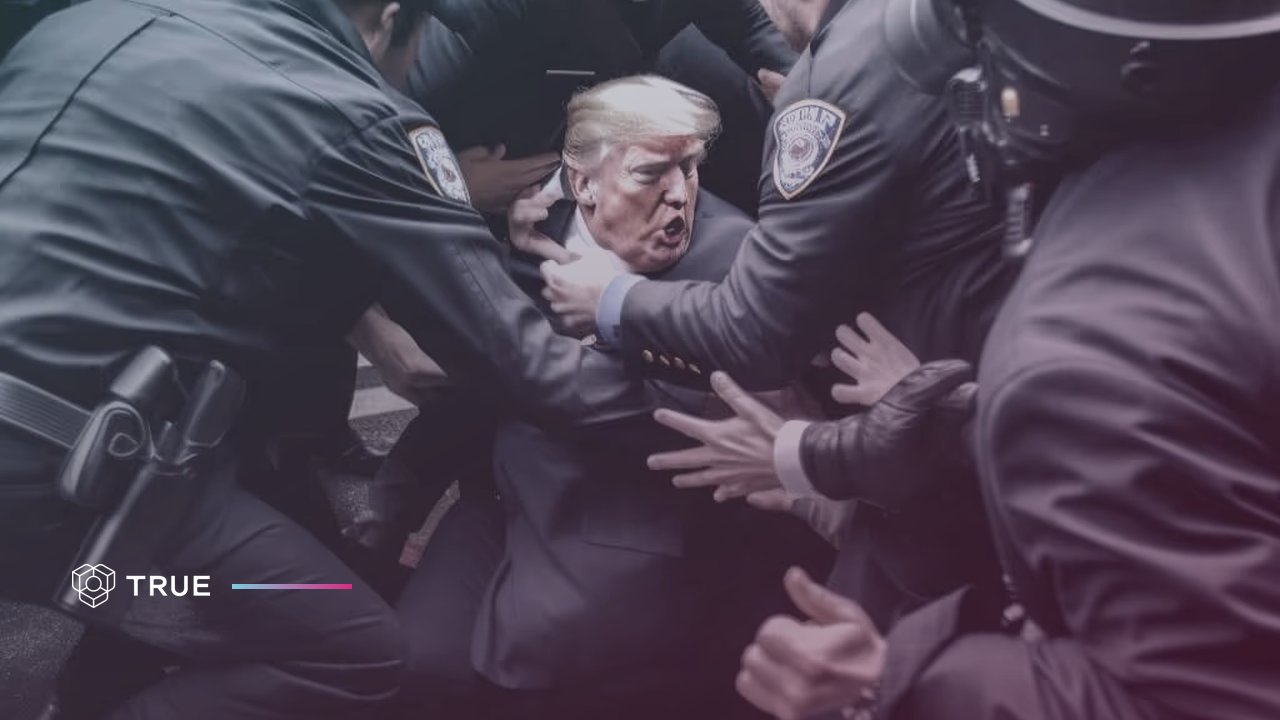
Fabrication no longer needs a print shop. The photograph at the top of this page never happened: Eliot Higgins, founder of Bellingcat, made it with the AI tool Midjourney in March 2023, and one Instagram post that shared his images as genuine collected more than 79,000 likes, according to PBS NewsHour.
People exposed most famous frauds, not systems. Whistleblowers Sherron Watkins at Enron and Cynthia Cooper at WorldCom, reporters at the Wall Street Journal, the Financial Times, the Los Angeles Times and CoinDesk, and researchers at West Virginia University brought seven of these nine cases to light. ACFE's 2026 Report to the Nations finds the same at scale: 43% of frauds were detected by a tip, more than half of them from employees.
Tips are the most common detection method in every ACFE report. Watkins wrote to her chairman; Cooper went to the board.
The Financial Times broke Wirecard, the Wall Street Journal broke Theranos and the Los Angeles Times exposed the pressure inside Wells Fargo. Journalists sit outside the organisation, which is why they can ask the question insiders cannot.
WorldCom's own internal auditors found its fraud. ACFE's 2026 data credits internal audit with 15% of detections. It works when auditors are independent of management and can see raw data rather than prepared reports.
Madoff and FTX fell when money had to leave faster than it came in. Madoff's scheme collapsed when the 2008 financial crisis triggered withdrawal requests he couldn't meet. Frauds that depend on fresh money break when the money stops.
Every method above is reactive: it waits for a person, a reporter or a crisis. Proactive verification checks the document against its issuer before anyone relies on it. When a certificate can be checked in seconds against the organisation that issued it, the forged Pfizer report and the spurious bank certificate stop working.
Organisations prevent fraud with layers of controls, and the layer ACFE's 2026 Report to the Nations links to the largest drop in losses is management review: median loss $84,000 with it, $186,000 without. Organisations with anti-fraud controls report losses more than 50% lower (ACFE 2024). ACFE found that all 18 anti-fraud controls it studied were associated with lower losses and faster detection. For organisations that issue certificates, diplomas or licences, one layer sits with them: making every document they issue verifiable at the source.
A document an outsider can check with its issuer in seconds removes the forger's main tool. That means issuing certificates and other credentials as tamper-evident digital documents with a QR code or link to verification, rather than PDFs that anyone can edit. It also means asking for verifiable credentials in hiring, compliance and partner decisions, as the guide to checking whether a CV is trustworthy describes.
Fraud grows where oversight belongs to the people being overseen. Adelphia's board belonged to the Rigas family; FTX had almost no board at all. Audit committees need members who answer to shareholders, and no single person should control a critical process from start to finish.
Since 43% of frauds are found by a tip (ACFE, 2026), a reporting channel is a prevention tool. It needs anonymity, legal protection for the reporter and visible follow-up.
An annual audit catches fraud after the fact. Proactive data monitoring, one of the four most effective controls in ACFE's 2026 study, watches transactions and document activity as they happen.
Regulation sets the floor: SOX for financial reporting in the United States, eIDAS for electronic documents and signatures in the EU. Records that cannot be changed after the fact make compliance easier to prove. More on the threats companies face is in the article on corporate fraud.
The most famous fraud cases include Bernie Madoff's Ponzi scheme, Enron, WorldCom, Theranos, Volkswagen's Dieselgate, Wirecard, Wells Fargo's fake accounts, Adelphia and FTX. Each ran for years on numbers or documents that nobody checked with their source, and most were exposed by a whistleblower, a journalist or a researcher.
The biggest fraud cases by financial impact include: (1) Enron, $74 billion in shareholder losses; (2) Bernie Madoff, $65 billion Ponzi scheme; (3) Volkswagen emissions scandal, $30+ billion in fines; (4) WorldCom, $11 billion accounting fraud; (5) FTX, $8+ billion in customer funds lost; (6) Wells Fargo, $3 billion in fines for fake accounts; (7) Wirecard, €1.9 billion missing. Bernie Madoff's Ponzi scheme is the case most often called the biggest: his final client statements showed about $65 billion that did not exist, and Judge Denny Chin said at sentencing in 2009 that "No other white collar case is comparable in terms of the scope, duration and enormity of the fraud and the degree of the betrayal." By estimated losses, CNN puts Enron's collapse at $74 billion.
A Ponzi scheme is an investment fraud that pays existing investors with money collected from new investors, according to the SEC's Investor.gov. It is named after Charles Ponzi, who duped investors with a postage stamp scheme in the 1920s, and Bernie Madoff ran the best-known modern example until it collapsed in December 2008.
Most frauds are detected by a tip: 43% of the 2,402 cases in ACFE's Occupational Fraud 2026: A Report to the Nations, with more than half of those tips coming from employees. Fraud is most commonly detected through: whistleblowers (43% of cases), internal audits (15%), management review (12%), and external audits or investigations.
Document fraud is how most financial fraud is hidden: the ACFE reports that fraudulent documents are involved in over 40% of occupational fraud cases, and according to ACFE's 2026 Report to the Nations, fraudsters altered physical documents in 33% of cases. In the famous cases, the forged documents included Madoff's client statements, Theranos lab reports with drug company logos added without permission, a bank certificate in the Wirecard case and forged customer signatures at Wells Fargo.
Organisations stop forged certificates by issuing them as digital originals that anyone can verify with the issuer, instead of PDFs that can be edited. TRUE Original issues certificates, diplomas, licences and other documents secured with blockchain technology, and anyone can check one in seconds in TRUE Verify by QR code or link.
Tamper-proof documents prevent credential fraud by letting anyone confirm, with the issuer and in seconds, that a certificate is genuine and unchanged. TRUE Original, a Swedish company, issues certificates, diplomas, licences, memberships and other documents secured with blockchain technology; over 900,000 documents have been issued through the platform. Each document can be checked in TRUE Verify by QR code or link, without calling the issuer.
For an organisation that issues documents, this is the Pfizer problem from the Theranos case turned around. Your name and logo are the asset a forger borrows. A training provider, a university or a certification body that issues digital originals gives every employer, regulator and partner a way to check its documents without phoning anyone, and a forged copy fails the check the first time someone looks. See how it works for certifications and certificates, or talk to us about your own documents.
Harry Markopolos had the arithmetic in 2000. By 2008, the SEC had still never asked a third party whether Madoff's trades existed.
Every organisation we work with started with the same question. Give us thirty minutes and we will show you what your own documents would be worth.
Book a callNot sure where to start? Let us help!

Trusted by leading organisations worldwide